





สินค้า
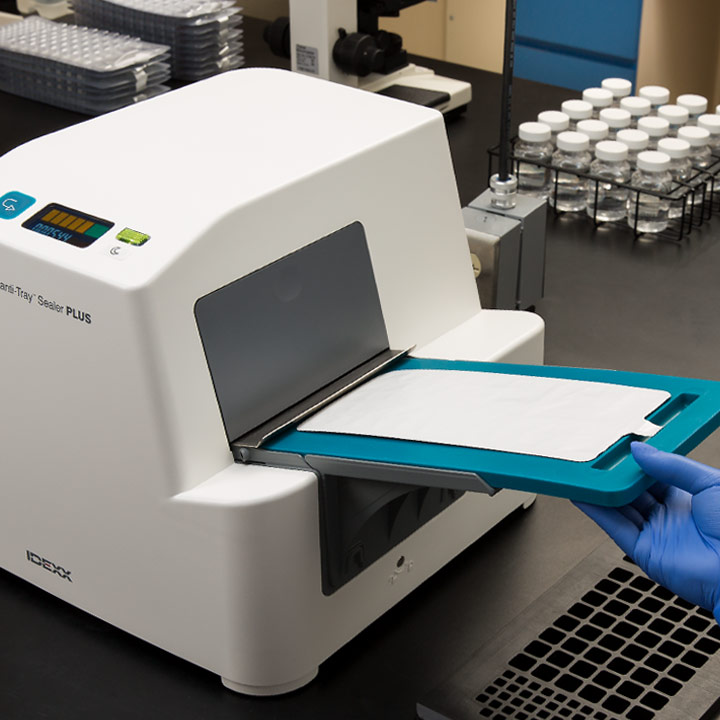
Quantitray Sealer Plus
Quanti-Tray System
Take the guesswork out of bacterial counts
- Provides easy, rapid, and accurate bacterial counts.
- Quanti-Tray and Quanti-Tray/2000 are used when quantifying coliforms, E. coli, enterococci, Pseudomonas aeruginosa, and Heterotrophic Plate Counts (HPC).
- The Quanti-Tray/Legiolert is only used to quantify Legionella pneumophila.
- The Quanti-Tray System delivers semiautomated quantification methods based on the Most Probable Number (MPN)model in Standard Methods for the Examination of Water and Wastewater.
- Learn more about the Quanti-Tray Sealer PLUS and upgrade today.
-
How Quanti-Tray works
Quanti-Tray
With Quanti-Tray, a 100 mL sample is divided into 51 wells. Then the Standard Methods’ Most Probable Number (MPN) approach is used to determine the number of bacteria in the original sample. Automation minimizes hands-on time and maximizes throughput (up to 4 samples per minute). The relatively large number of wells provides a high counting range of 1–200 (without dilutions) and very tight 95% confidence limits.
Quanti-Tray/2000
The Quanti-Tray/2000 is based on the same statistical model as the traditional 15-tube serial dilution. With the Quanti-Tray/2000, the sample is automatically divided into the proper portions when sealed by the Quanti-Tray Sealer PLUS. The Quanti-Tray system does not require the use of test tubes, Durham tubes, or any dilutions. By automatically distributing the sample into 97 wells of 2 different sizes, Quanti-Tray/2000 yields a counting range of 1–2,419 with a far better 95% confidence limit than a 15-tube serial dilution.
Quanti-Tray/Legiolert
With Quanti-Tray/Legiolert, a 100 mL sample is divided into 96 wells. The Standard Methods’ Most Probable Number (MPN) approach is used to determine the number of bacteria in the original sample, using the MPN tables provided. Automation minimizes hands-on time and maximizes throughput (up to four samples per minute). The 96-well tray provides a counting range of 1–2,272 (without dilutions).
